


For many Americans, the idea of moving to Canada from the US has shifted from daydream to serious consideration. Healthcare costs, family priorities, work-life balance, political uncertainty, and the search for a more predictable quality of life are driving the conversation. Yet relocating from the United States to Canada is never just a change of scenery. It is an immigration process, a tax and financial planning exercise, a housing decision, and a career move all at once.
Immigration to Canada can offer real advantages, but it also comes with clear trade-offs: expensive housing in major cities, lower salaries in some professions, healthcare wait times, higher consumer prices in certain categories, and a more complex cross-border tax life. This 2026 guide gives U.S. citizens and residents a realistic, up-to-date overview of what it takes to move to Canada from the US, what has changed in immigration policy, which pathways remain available, and what to expect once you arrive.
This article is general information only and is not legal, immigration, tax, or financial advice. Immigration rules change frequently. Always verify your eligibility directly with IRCC or a licensed Canadian immigration professional before making decisions.
What Changed in Canada’s Immigration System in 2026?
Canada’s immigration system remains open to skilled workers, business owners, and people with in-demand experience, but the overall tone has shifted toward sustainability. The 2026–2028 Immigration Levels Plan focuses on lower temporary resident arrivals while stabilizing permanent resident admissions at 380,000 per year through 2028, with economic immigration forming the largest share.
For Americans, the most important 2026 updates include:
- The federal Start-Up Visa Program is paused for new applicants as of January 1, 2026. People who received a valid 2025 commitment certificate must apply by June 30, 2026.
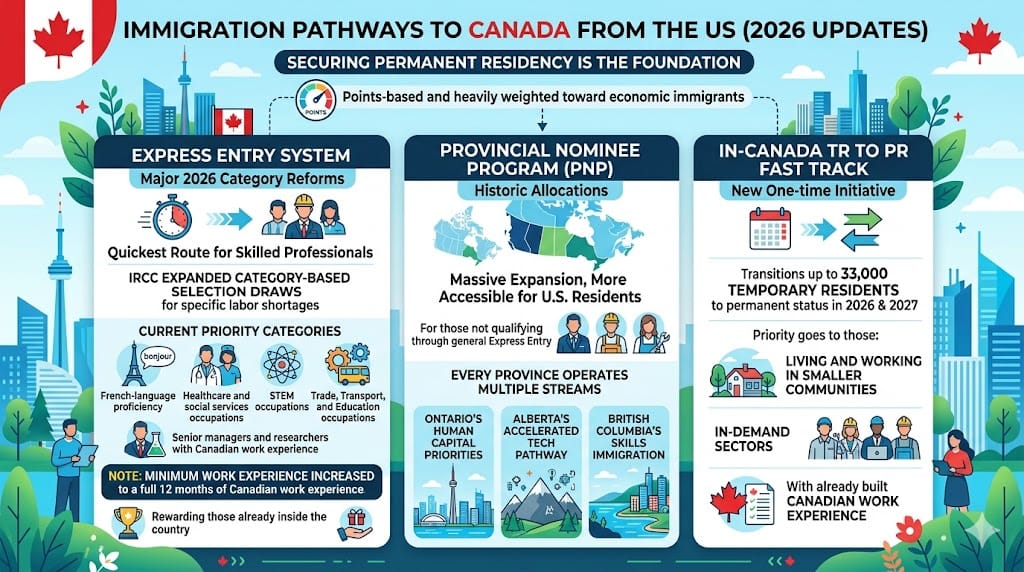
- Express Entry continues to use category-based draws targeting French-language ability and specific priority occupations.
- A one-time In-Canada Workers Initiative aims to accelerate permanent residence for up to 33,000 workers already contributing in Canada, with emphasis on in-demand sectors and smaller communities.
Why Many Americans Are Considering a Move to Canada
The appeal is easy to understand. Canada offers publicly funded healthcare, strong public schools, diverse and safe cities, a relatively stable political environment, and a culture that often feels familiar to Americans while still being distinctly different.
For families, everyday risks can feel more manageable: medical costs are less likely to become catastrophic, public education is generally strong, and parental leave and employment protections are more robust than many Americans are used to. For professionals, Canada can provide a different kind of career stability even if the overall job market is smaller. For entrepreneurs, access to talent and proximity to the U.S. market remain attractive, though the Start-Up Visa pause means business owners must plan more carefully in 2026.
The Reality Check: What Americans Often Underestimate When Moving to Canada from the US
Moving to Canada from the US can be a good decision, but it is not automatically an easier or cheaper life.
Housing remains the biggest shock for most newcomers. Toronto and Vancouver continue to be extremely expensive, and affordability pressures have spread to many other Canadian markets. Salaries in some professions (particularly technology, medicine, finance, and executive roles) can be lower than U.S. equivalents, and the weaker Canadian dollar can make the gap feel larger when comparing compensation directly.
Healthcare is not instant or unlimited. Newcomers must apply for provincial or territorial health coverage, and in some provinces, public coverage may not begin for up to three months. Prescription drugs, dental care, and vision services are often not covered by public plans. Taxes and consumer costs can also be higher depending on the province.
The honest framing is this: Canada may offer more predictability and a stronger social safety net, while the U.S. may offer higher earning potential and a larger domestic market. The right choice depends on your career stage, family situation, immigration eligibility, and long-term financial plan.
Immigration Pathways for Americans in 2026
Express Entry remains Canada’s main online system for managing economic immigration applications under the Federal Skilled Worker Program, Federal Skilled Trades Program, and Canadian Experience Class. You create a profile, receive a Comprehensive Ranking System (CRS) score, and may receive an invitation to apply for permanent residence. Category-based draws allow Canada to invite candidates who meet specific labour-market needs.
Express Entry
Express Entry can be a strong fit if you are a skilled professional with strong education and work history, under 40 (or able to offset age with other strengths), fluent in English and/or French, working in a priority occupation, and able to obtain an Educational Credential Assessment and language test results.
French-language ability remains a major advantage. Even moderate-to-strong French test scores can meaningfully improve your competitiveness in category-based draws.
Provincial Nominee Programs (PNPs)
Provincial Nominee Programs (PNPs) allow Canadian provinces and territories to nominate people who have the skills, education, work experience, or business background needed in that specific region. A nomination through an Express Entry-aligned stream can add 600 CRS points, which is often enough to secure an invitation to apply.
PNPs are especially valuable if your profile is strong but not yet competitive in a general Express Entry draw, or if you already know which province you want to live in.
Business and Entrepreneur Options in 2026
Because the federal Start-Up Visa Program is paused for new applicants, entrepreneurs should explore provincial entrepreneur streams, business purchase options, intra-company expansion, or work-permit-first strategies.
A practical business route usually involves demonstrating real economic benefit to Canada, hiring or planning to hire Canadians, building Canadian revenue and operations, and using that activity to support a later permanent residence application. The right structure depends heavily on the business type, chosen province, available capital, and whether the owner needs to relocate immediately.
Work Permits and Employer-Supported Routes
Some Americans move first on a work permit and apply for permanent residence later. This route can be effective when the Canadian job builds local work experience or creates eligibility for a provincial stream. Canada’s Global Skills Strategy aims to process eligible work permit applications for certain highly skilled workers within two weeks. Americans may also have options under CUSMA trade-agreement categories, though these are highly fact-specific.
Related link: Canada Immigration Overview
Cost of Living: What Really Changes After Moving to Canada from the US
Your budget will not simply become cheaper or more expensive. It will change shape.
You may spend less on healthcare premiums, deductibles, and emergency medical bills. You may also pay significantly less for university tuition if you or your children become domestic students. However, you will likely spend more on housing in major metros, groceries and consumer goods in some categories, mobile phone and internet plans, and cross-border tax preparation. Sales taxes vary significantly by province.
Alberta, for example, has no provincial sales tax, while other provinces layer PST, HST, or QST on top of the federal GST.
Healthcare in Canada for Newcomers from the US
Canada’s public healthcare system is one of the biggest reasons Americans consider moving to Canada from the US. Once covered by a provincial or territorial health plan, many medically necessary doctor and hospital services are publicly funded. This can greatly reduce the risk of catastrophic medical bills.
However, it is important to understand the limitations. Newcomers may face a waiting period before public coverage begins. Many Canadians wait for family doctors. Public plans usually do not cover outpatient prescription drugs, routine dental care, or vision care. For Americans accustomed to fast specialist access through private insurance, this can require an adjustment in expectations.
Taxes: The Cross-Border Challenge You Cannot Ignore
Taxes become significantly more complicated when a U.S. citizen moves to Canada. Canada taxes residents on worldwide income, and the U.S. generally requires citizens and resident aliens abroad to continue filing U.S. tax returns on worldwide income.
Foreign tax credits and the Canada-U.S. tax treaty often reduce or eliminate double taxation, but they do not remove the paperwork burden. Many U.S. citizens in Canada also need to consider FBAR and FATCA reporting for foreign financial accounts or assets above certain thresholds.
Before moving, speak with a cross-border tax professional about U.S. and Canadian residency dates, foreign tax credits, retirement accounts, brokerage accounts, stock options and RSUs, business ownership, FBAR/FATCA requirements, and any applicable state tax exit issues. Do this planning before you move, not after your first Canadian tax year.
Best Canadian Cities for Americans Moving from the US
No single city is best for everyone. The right choice depends on your industry, family needs, budget, climate preference, and long-term goals.
Toronto, Ontario
Canada’s largest business hub and a strong fit for finance, consulting, technology, media, healthcare, and corporate roles. It is diverse and globally connected, but housing is expensive and competition for jobs and rentals is intense.
Vancouver, British Columbia
Offers mild weather, ocean access, mountains, and strong industries in technology, film, trade, tourism, and sustainability. One of the most beautiful cities in North America, but also one of the least affordable. Best suited for people with higher incomes or remote U.S.-based income.
Calgary, Alberta
A practical choice for many Americans. Strong energy sector, growing technology scene, lower housing costs than Toronto or Vancouver, and no provincial sales tax. Cold winters, but sunny, business-friendly, and close to the Rocky Mountains.
Ottawa, Ontario
A strong option for families, public-sector workers, technology professionals, and people who want a quieter lifestyle than Toronto. Good schools, relative stability, and access to both English and French Canada.
Montreal, Quebec
Culturally rich, relatively affordable compared with Toronto and Vancouver, and strong in gaming, AI, aerospace, education, and the arts. Long-term professional and social integration is much easier if you learn at least basic French.
Edmonton, Alberta
Often overlooked, but it can offer a lower cost of living, strong public institutions, healthcare and education jobs, and access to Alberta’s tax advantages. Cold winters, but worth serious consideration for families and budget-conscious movers.
Final Takeaway: Is Moving to Canada from the US the Right Decision in 2026?
Moving from the United States to Canada in 2026 can be a smart decision, but it should be approached with clear eyes. Canada is not a cheaper version of the U.S., and it is not a guaranteed escape from financial stress. It is a different system with different strengths.
The strongest candidates are usually those who combine realistic expectations with a clear immigration pathway, a job or business plan, enough savings, and a willingness to adapt to Canadian costs, climate, taxes, and public services. For the right person or family, Canada can offer exactly what they are looking for: stability, community, access to public healthcare, strong schools, and a long-term path to permanent residence.
The move works best when it is planned like a major financial and legal transition, not just a lifestyle upgrade.