


Important 2026 Update on Business Immigration to Canada
Business immigration to Canada remains an important option for entrepreneurs, investors, business owners, and experienced managers who want to establish or expand their business presence in Canada. However, applicants should be aware that several federal business immigration programs have changed significantly.
As of 2026, Canada’s Start-Up Visa Program is paused for most new applicants. The Federal Self-Employed Persons Program is also paused and is not accepting new applications. Because of these changes, many applicants are now reviewing Provincial Nominee Programs, Québec business immigration programs, and other business-related pathways that may better match their profile.
Before applying, always verify the latest program status, eligibility rules, investment requirements, and application process through official government sources or a licensed immigration professional.
Why Choose Canada for Business Immigration?
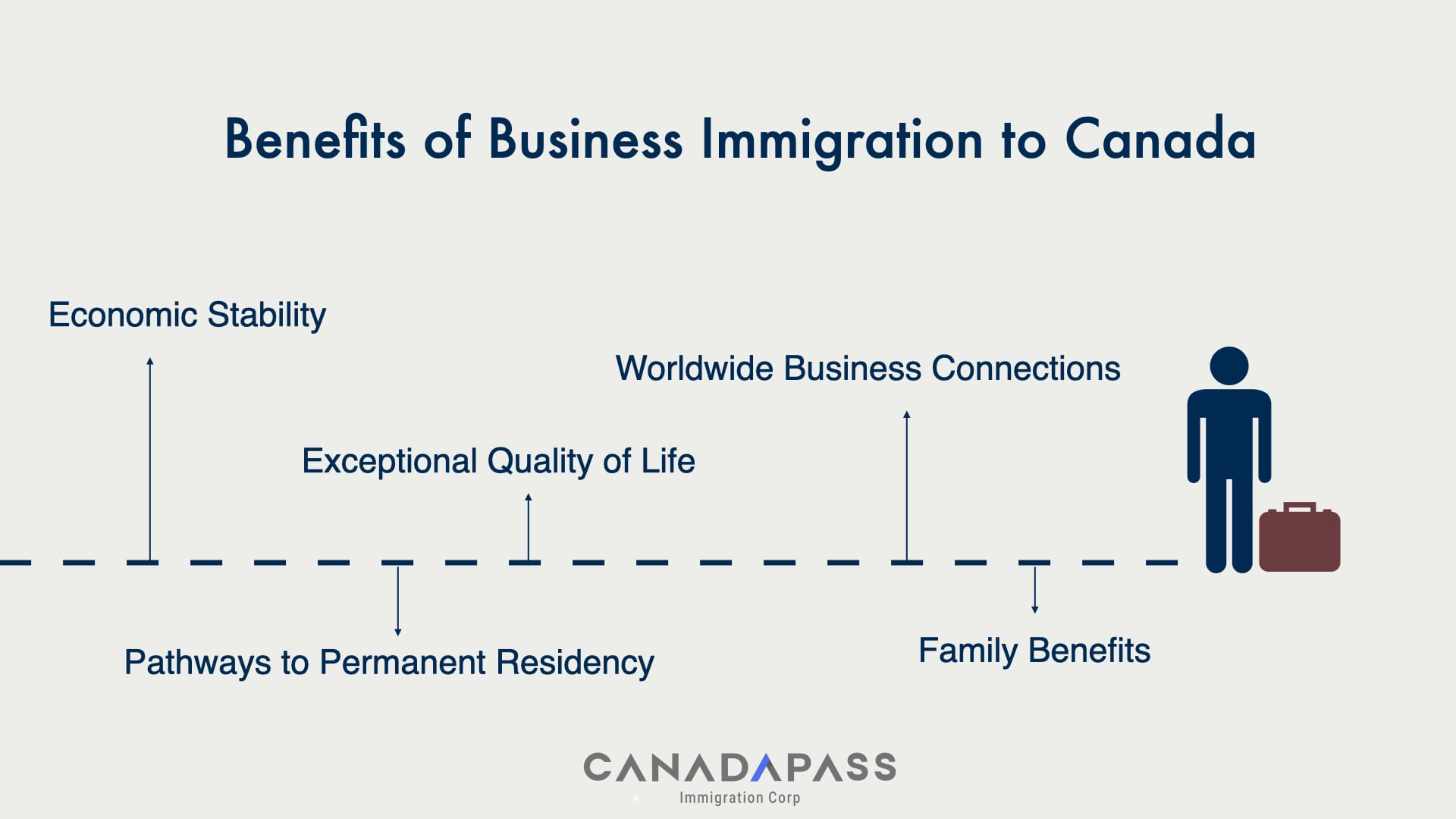
Canada is one of the most attractive destinations for entrepreneurs and investors because it offers a stable economy, a transparent legal system, access to North American markets, and a high quality of life.
Business immigration to Canada may allow qualified applicants to build a company, invest in a business, create employment opportunities, and pursue permanent residence through eligible immigration pathways.
Canada is also known for its multicultural environment and strong immigrant business community. Immigrant entrepreneurs contribute to job creation, innovation, local economic growth, and regional development across the country.
Some of the main reasons entrepreneurs and investors consider Canada include:
Access to a developed and stable economy
Opportunities in sectors such as technology, agriculture, clean energy, manufacturing, healthcare innovation, and tourism
Transparent business, banking, and legal systems
Pathways that may support permanent residence
Settlement opportunities for eligible family members
Access to public services after meeting provincial or territorial eligibility rules
Strong regional demand for business investment in selected provinces and communities
What Is Business Immigration to Canada?
Business immigration to Canada refers to immigration pathways designed for people who want to contribute to the Canadian economy through business ownership, investment, entrepreneurship, or self-employment.
These programs may be suitable for:
Entrepreneurs who want to start a business in Canada
Business owners who want to buy or expand a business
Investors with significant financial capacity
Senior managers with business management experience
Founders with innovative business ideas
Self-employed professionals who meet specific program requirements
Applicants who can create jobs or support regional economic development
The exact requirements depend on the program. Some business immigration pathways require a minimum investment, minimum net worth, language test results, a business plan, job creation, active business management, or a performance agreement.
Main Business Immigration Pathways in Canada
Business immigration options in Canada can generally be divided into three main categories:
Federal business immigration programs
Provincial Nominee Program business streams
Québec business immigration programs
Federal Business Immigration Programs in Canada
Federal business immigration programs are managed by Immigration, Refugees and Citizenship Canada, also known as IRCC. In previous years, the most recognized federal business pathways included the Start-Up Visa Program and the Federal Self-Employed Persons Program.
In 2026, both programs require careful attention because they are paused or restricted.
Start-Up Visa Program Canada
The Start-Up Visa Program was created for immigrant entrepreneurs with innovative business ideas that could create jobs in Canada and compete internationally.
Traditionally, applicants needed support from a designated Canadian organization, such as:
A venture capital fund
An angel investor group
A business incubator
Although the program did not require every applicant to make a fixed personal investment, applicants still needed a qualifying commitment or support from a designated organization.
Start-Up Visa Program 2026 update
As of January 1, 2026, the Start-Up Visa Program is paused. Only applicants with a valid 2025 commitment certificate may apply until June 30, 2026. Applicants without a valid 2025 commitment certificate should not treat the Start-Up Visa Program as an open pathway.
For most entrepreneurs starting their research in 2026, it is better to review provincial entrepreneur streams, Québec business immigration options, or other suitable immigration pathways.
Federal Self-Employed Persons Program
The Federal Self-Employed Persons Program was designed for individuals with relevant experience in cultural activities or athletics who could make a significant contribution to Canada’s cultural or athletic life.
This program is currently paused and is not accepting new applications.
Self-employed applicants should not assume that the federal self-employed pathway is available. Depending on their profile, they may need to review Québec’s self-employed worker program, provincial options, or other immigration routes.
New Federal Entrepreneur Pilot: What Applicants Should Know
IRCC has indicated that future entrepreneur-focused immigration measures may be developed, but applicants should be careful with unofficial claims about a new federal entrepreneur pilot.
As of now, detailed eligibility criteria, investment requirements, application caps, launch dates, and program conditions have not been fully published. For this reason, applicants should avoid relying on speculative information and should monitor official IRCC updates before making decisions.
Provincial Nominee Programs for Business Immigration
Provincial Nominee Programs, often called PNPs, are among the most important business immigration options to review in 2026. Many provinces offer entrepreneur or investor streams designed to attract experienced business owners who can support local economic development.
These programs usually focus on applicants who can actively manage a business in the province. Many PNP business streams require a business plan, minimum net worth, minimum investment, job creation, business ownership or senior management experience, and the intention to live in the province.
PNP business immigration programs may be suitable for applicants who want to start, buy, or expand a business in a specific Canadian province.
Examples of Provincial Business Immigration Streams
The following examples are provided as a general overview. Requirements can change, and each applicant should verify the latest rules on the official provincial website before applying.
| Province | Example Business Stream | General Focus |
|---|---|---|
| British Columbia | Entrepreneur Immigration | For experienced entrepreneurs who want to establish or purchase a business in B.C. |
| Manitoba | Business Investor Stream | For business owners and investors interested in establishing or purchasing a business in Manitoba |
| Alberta | Entrepreneur-related streams | Includes options that may focus on rural communities, innovation, or graduates |
| Nova Scotia | Entrepreneur Stream, including International Graduate Entrepreneur sub-criterion | For experienced entrepreneurs and eligible graduates |
| New Brunswick | Business Immigration Stream | For applicants with business ownership or senior management experience |
| Prince Edward Island | Work Permit Stream | For applicants who want to operate a business in PEI |
| Newfoundland and Labrador | International Entrepreneur | For experienced business owners and senior managers |
This table should be treated as a starting point, not as a substitute for official eligibility review.
PNP Business Immigration Requirements: Common Factors
Although each province has its own rules, many provincial entrepreneur streams assess similar factors, such as:
Business ownership or senior management experience
Minimum personal net worth
Minimum eligible investment
English or French language ability
Business plan or business concept
Job creation for Canadian citizens or permanent residents
Active management of the business
Intention to live in the nominating province
Legal source of funds
Possible exploratory visit or interview
Performance agreement after approval
Applicants should also understand that meeting the minimum requirements does not guarantee selection. Many programs use a points-based Expression of Interest system or select applicants based on regional economic priorities.
Québec Business Immigration Programs
Québec operates its own immigration selection system. Its business immigration programs are separate from federal programs and from other provincial nominee programs.
Québec business immigration may be suitable for investors, entrepreneurs, and self-employed workers who intend to live and conduct business in Québec.
Applicants should pay close attention to French-language requirements, business conditions, net worth rules, investment requirements, and Québec-specific selection criteria.
Québec Immigrant Investor Program
The Québec Immigrant Investor Program is designed for high-net-worth applicants who want to settle in Québec and meet the program’s investment and selection requirements.
Applicants should not describe this program simply as a passive investment route. Québec’s current investor pathway includes specific conditions related to net worth, French-language ability, management experience, education, investment agreements, required investment, financial contribution, and Québec stay requirements.
Because the program is highly specific and can change, applicants should verify the latest Québec investor conditions before preparing an application.
Québec Entrepreneur Program
The Québec Entrepreneur Program is designed for applicants who want to start, acquire, or operate a business in Québec.
This pathway may be suitable for entrepreneurs with a clear business project, relevant experience, and the ability to meet Québec’s language, business, and financial requirements.
Applicants should prepare a strong business plan and ensure that their proposed business aligns with Québec’s program rules and economic expectations.
Québec Self-Employed Worker Program
The Québec Self-Employed Worker Program may be an option for qualified professionals who want to establish themselves as self-employed workers in Québec.
This program is different from the Federal Self-Employed Persons Program, which is currently paused. Applicants should review Québec’s specific rules, including professional experience, financial capacity, settlement requirements, and French-language expectations.
General Eligibility Requirements for Business Immigration to Canada
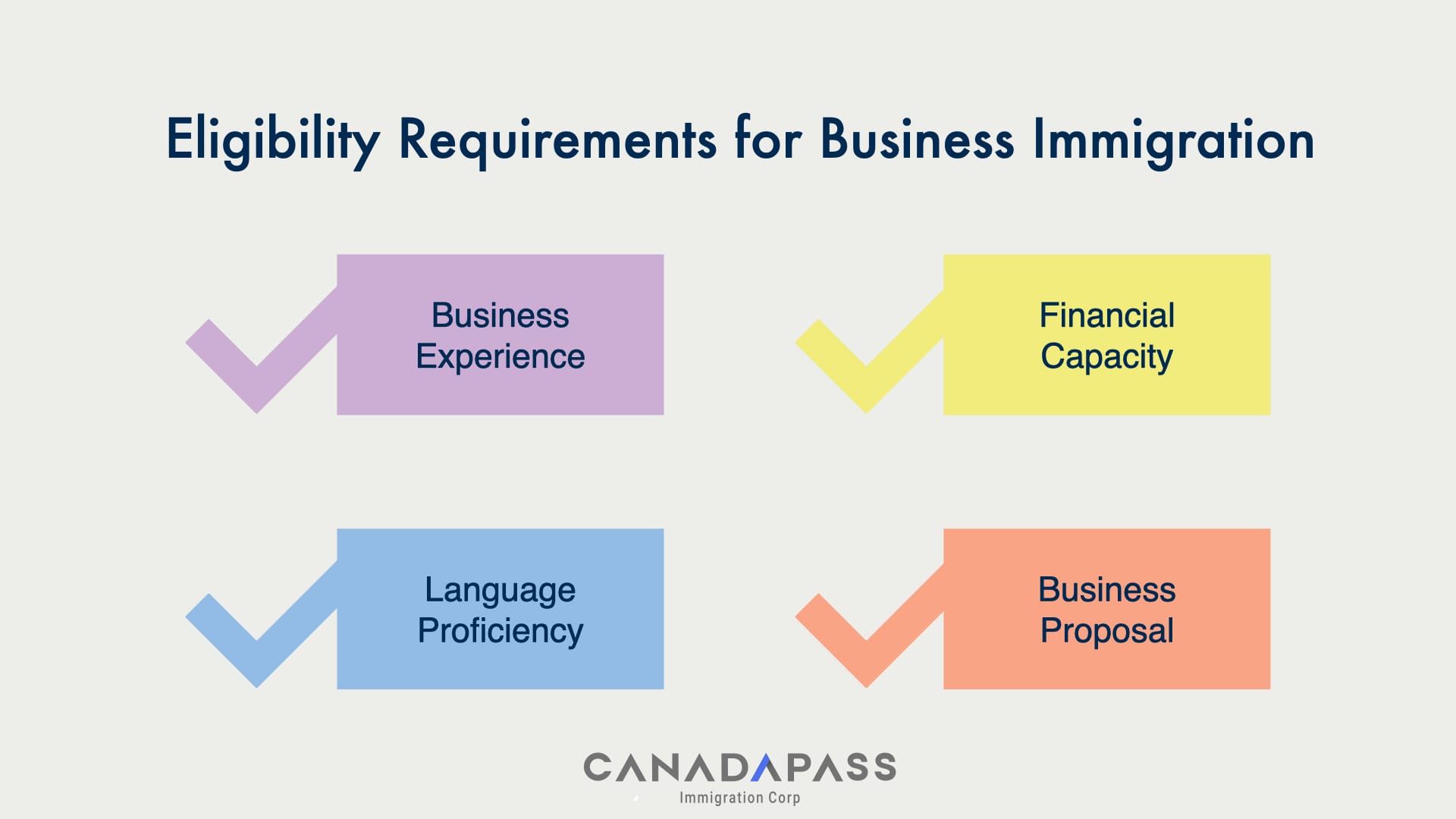
Eligibility requirements vary by program, province, and business category. However, most business immigration pathways assess several core factors.
Business or Management Experience
Applicants usually need to prove that they have owned, managed, or operated a business. Some programs may also accept senior management experience.
Useful documents may include company registration records, ownership documents, tax records, financial statements, employment letters, organizational charts, contracts, business licenses, and proof of business activity.
Net Worth and Investment Capacity
Many business immigration programs require applicants to prove a minimum personal net worth and the ability to make an eligible investment.
The required amount varies significantly by program. Provincial entrepreneur streams may have lower investment thresholds than investor programs, while Québec investor requirements are usually much higher.
Legal Source of Funds
Applicants may need to show that their funds were obtained legally. This can be one of the most important and detailed parts of a business immigration application.
Documents may include tax records, salary records, business sale agreements, dividend records, property sale documents, bank statements, inheritance documents, or other financial evidence.
Language Proficiency
Most business immigration programs require proof of English or French language ability. The required Canadian Language Benchmark, often called CLB, varies by program.
French is especially important for Québec business immigration. In some Québec pathways, French-language ability is not just an advantage but a key requirement.
Business Plan
A strong business plan is often essential. The plan should explain the business idea, target market, operations, investment, hiring plan, financial projections, and local economic benefits.
A generic or unrealistic business plan can weaken an application. The strongest plans are specific to the province, city, industry, and target customer base.
Active Business Management
Many entrepreneur programs require applicants to actively manage the business after arriving in Canada. This means the applicant may need to live in or near the province where the business operates and participate in daily management.
Applicants who want a purely passive investment route should carefully check whether the program allows passive investment.
Step-by-Step Guide to Business Immigration to Canada
1. Define Your Business and Immigration Goals
Start by identifying your main goal. Do you want to start a new business, buy an existing business, expand your company into Canada, invest passively, or become self-employed?
Your goal will determine which programs are realistic.
2. Compare Federal, Provincial, and Québec Options
Review available programs based on your experience, net worth, investment capacity, language ability, preferred location, and business sector.
Because some federal programs are paused or restricted, provincial and Québec pathways may be more relevant for many applicants in 2026.
3. Check Current Program Status
Before preparing documents, confirm whether the program is open, paused, restricted, or accepting new applications.
Business immigration programs can change quickly, and outdated information can lead to wasted time and money.
4. Review Eligibility Requirements
Check the program’s requirements for:
Net worth
Investment amount
Business experience
Language ability
Education
Job creation
Business ownership
Active management
Settlement intention
Source of funds
5. Prepare Financial and Business Documents
Gather documents that prove your business background, financial capacity, ownership history, and legal source of funds.
This stage can take time, especially for applicants with complex business structures or multiple sources of income.
6. Create a Business Plan
Your business plan should be tailored to the province or region where you want to operate.
It should include market research, competitor analysis, investment details, hiring projections, operating costs, revenue assumptions, and local economic benefits.
7. Submit an Expression of Interest or Application
Many PNP entrepreneur streams use an Expression of Interest system. If your profile is competitive, you may receive an invitation to apply.
Other programs may require direct application, business concept submission, interview, or additional documentation.
8. Attend an Interview or Exploratory Visit if Required
Some programs require or recommend an exploratory visit. Others may request an interview to assess your business plan, experience, and commitment to the province.
9. Sign a Performance Agreement
Many entrepreneur streams require applicants to sign a performance agreement. This document outlines the business commitments you must fulfill after approval or arrival.
Commitments may include investment amount, job creation, business operation, location, and management responsibilities.
10. Receive Nomination, Selection, or Approval
Depending on the program, you may receive a provincial nomination, Québec selection certificate, or another form of approval that supports the next immigration step.
11. Apply for Permanent Residence
After nomination or selection, eligible applicants usually submit a permanent residence application to the federal government.
Federal processing includes medical, security, criminality, and admissibility checks.
12. Establish or Manage the Business in Canada
After arrival, applicants must follow the conditions of their program and business agreement. This may include investing the required funds, hiring employees, operating the business, and reporting progress to the province.
Processing Time for Business Immigration to Canada
Processing times vary widely depending on the program, province, application volume, background checks, documentation quality, and government backlogs.
Applicants should avoid relying on a single fixed processing time. Some pathways may move faster, while others may take significantly longer.
The safest approach is to check the latest official processing information for the specific program before making business, financial, or relocation plans.
Best Industries for Business Immigration to Canada
The best business opportunity depends on the province, local market demand, applicant experience, investment amount, and long-term business plan.
Common sectors that may offer opportunities include:
Technology and software
Artificial intelligence
Agriculture and agri-food
Clean energy and sustainability
Healthcare innovation
Construction and skilled trades
Manufacturing
Tourism and hospitality
Logistics and supply chain services
Retail and franchise businesses
Professional services
Applicants should not choose an industry only because it sounds popular. A successful business immigration application usually requires a realistic business model, local market research, and evidence that the applicant can operate the business successfully.
Common Challenges in Business Immigration to Canada
Changing Program Rules
Business immigration programs can pause, close, reopen, or change requirements with little notice. Applicants should verify program status before investing in a business plan or application.
Proving Source of Funds
Source of funds documentation can be complex. Applicants should prepare clear evidence showing how their money was earned, saved, invested, inherited, or transferred.
Weak Business Plans
A business plan that is too generic, unrealistic, or not connected to local market conditions may weaken the application.
Language Requirements
Some applicants underestimate the importance of language ability. Stronger English or French skills can improve both immigration eligibility and business success.
Regional Commitment
Many PNP business streams require applicants to live and operate the business in the nominating province. Applicants should choose a province where they genuinely intend to settle and do business.
Business Performance Conditions
Some programs require applicants to meet business commitments before receiving a final nomination or moving forward in the process. Failure to meet these commitments may affect nomination, selection, or future application steps, depending on the program and stage of the application.
Is Business Immigration to Canada Right for You?
Business immigration to Canada may be suitable if you have:
Real business ownership or management experience
Sufficient net worth and investment capacity
A clear and realistic business plan
The ability to prove the legal source of your funds
English or French language ability
A genuine intention to live and operate a business in Canada
Patience for a detailed and document-heavy application process
It may not be suitable if you are looking for a guaranteed, fast, or passive route to permanent residence. Many business immigration programs require active participation, business risk, financial commitment, and long-term planning.
FAQ About Business Immigration to Canada
What is business immigration to Canada?
Business immigration to Canada refers to immigration pathways for entrepreneurs, investors, business owners, senior managers, and self-employed professionals who want to contribute to the Canadian economy through business activity, investment, or professional work.
Is the Start-Up Visa Program open in 2026?
The Start-Up Visa Program is paused for most new applicants in 2026. Applicants with a valid 2025 commitment certificate may have a limited transitional opportunity, but new applicants should review other available business immigration options.
Can I move to Canada by starting a business?
In some cases, yes. Several provincial and Québec programs are designed for entrepreneurs who want to start, purchase, or manage a business in Canada. Requirements vary by province and program.
How much money do I need for business immigration to Canada?
The required amount depends on the program. Some entrepreneur streams require a minimum investment and minimum net worth, while investor programs may require significantly higher financial capacity.
Do I need a business plan?
Most entrepreneur and provincial business immigration programs require a business plan or business concept. The plan should explain the business idea, market, investment, job creation, financial projections, and local economic benefit.
Can my family come with me?
In many permanent residence pathways, eligible family members such as a spouse or dependent children may be included in the application. The exact rules depend on the program and application type.
Do I need English or French for business immigration to Canada?
Most business immigration programs require proof of English or French language ability. Québec programs often place strong emphasis on French-language proficiency.
Which provinces offer business immigration programs?
Several provinces offer entrepreneur or business immigration streams, including British Columbia, Manitoba, Saskatchewan, Alberta, Nova Scotia, New Brunswick, Prince Edward Island, and Newfoundland and Labrador. Availability and requirements can change, so applicants should verify the latest provincial rules.
What happens if my business does not succeed?
The consequences depend on the program, the stage of your application, and the specific commitments you made. If you fail to meet required business commitments, it may affect nomination, selection, or future application steps.
Should I hire an immigration consultant or a lawyer?
Business immigration applications can be complex. Many applicants choose to work with a licensed immigration consultant or lawyer to review eligibility, prepare documents, and reduce the risk of mistakes.
Final Thoughts
Business immigration to Canada remains a valuable option for qualified entrepreneurs, investors, and business owners, but the landscape has changed. In 2026, applicants should not assume that all federal business immigration programs are open.
The Start-Up Visa Program and Federal Self-Employed Persons Program are paused or restricted, making provincial entrepreneur streams and Québec business immigration programs especially important to review.
The right pathway depends on your business background, investment capacity, preferred province, language ability, source of funds, and long-term settlement goals. Before applying, review the latest official requirements and seek professional guidance if needed.
Interested in business immigration to Canada?
Start by checking your eligibility, comparing available provincial and Québec programs, and preparing a realistic business plan. For personalized advice, speak with a licensed immigration consultant or immigration lawyer before making financial or application decisions.
Disclaimer
This guide is for general informational purposes only and does not constitute legal advice. Immigration programs, eligibility requirements, investment thresholds, and processing rules can change. Always verify the latest information through official government sources or a licensed immigration professional before applying.