


Last updated: May 22, 2026. This guide explains the main ways to immigrate to Canada from Qatar in 2026, including Express Entry, business immigration, Provincial Nominee Programs, family sponsorship, and the study-to-PR route.
Immigration rules change frequently, so always confirm the latest requirements on the official Immigration, Refugees and Citizenship Canada website or speak with a licensed Canadian immigration lawyer or RCIC before applying.
Canada remains a strong destination for professionals, entrepreneurs, students, and families living in Qatar. However, the immigration system has become more selective, especially for temporary residents and business applicants. Many applicants also compare the broader benefits of immigrating to Canada before deciding which pathway fits their long-term goals.
In 2026, Canada plans to admit 380,000 permanent residents, with economic immigration making up a major share of the national immigration plan. According to the official 2026–2028 Immigration Levels Plan, Canada is also reducing temporary resident arrivals to support more sustainable population growth.
For applicants living in Qatar, the best pathway depends on your citizenship, education, work experience, language ability, family situation, funds, and whether you want to work, study, invest, or settle permanently in Canada. For applicants who are still comparing options, the table below helps to first understand the main Canada immigration pathways before choosing between Express Entry, business immigration, study permits, or family sponsorship.
| Applicant Profile | Best Canadian Immigration Pathway |
|---|---|
| Skilled professional with strong English or French | Express Entry or Provincial Nominee Program |
| Business owner or investor in Qatar | C11 work permit or PNP entrepreneur stream |
| Executive transferring within a multinational company | Intra-Company Transfer work permit |
| Student planning a long-term PR route | Study permit, PGWP, then Express Entry or PNP |
| Applicant with a Canadian spouse or close family member | Family sponsorship or Super Visa |
Key Canada Immigration Changes in 2026
Canada’s 2026 immigration system is different from previous years, especially for entrepreneurs, international students, and temporary residents. Applicants from Qatar should understand these changes before choosing a pathway.
| Area | 2026 Update |
|---|---|
| Permanent residence target | 380,000 new permanent residents |
| Economic immigration | 239,800 planned admissions |
| Temporary resident arrivals | 385,000 planned new arrivals |
| Start-Up Visa Program | Paused for most new applicants as of January 1, 2026 |
| Self-Employed Persons Program | Paused until further notice |
| Permanent residence fees | Increased on April 30, 2026 |
| Ontario Entrepreneur Stream | Wound down and closed to new applications |
The Start-Up Visa Program is now paused, and designated organisations have stopped issuing commitment certificates after December 31, 2025. Applicants who already had a valid 2025 commitment certificate must apply by June 30, 2026, according to the official IRCC Start-Up Visa page.
Practical Application Steps for Applicants Living in Qatar
Applying from Qatar is not just about choosing a program. You also need to prepare local documents, book biometrics, complete medical exams when required, and make sure your proof of funds is clear and accessible.
Police Clearance Certificate in Qatar
Many Canadian immigration applications require police certificates, and applicants living in Qatar may need a Qatari Police Clearance Certificate, also known as a Good Conduct Certificate. The official Qatar Ministry of Interior provides information through its Police Clearance Certificate service.
If you are a current resident in Qatar, prepare your Qatar ID, passport copy, photos, and any additional documents requested by the Ministry of Interior. Former residents may need extra steps, including fingerprint documents and previous residence details.
Biometrics in Doha
Most Canadian visa and immigration applicants must give biometrics, which means fingerprints and a photo. Canada’s official website explains that biometrics outside Canada are collected through Visa Application Centres, and appointments must be booked in advance through the official Canada VAC finder.
Do not pay anyone for a biometrics appointment itself, because IRCC states that biometrics appointments are free, although VAC service fees may apply for other services. Always follow the instructions in your Biometrics Instruction Letter.
Medical Exams for Canada Immigration
Some applicants must complete an immigration medical exam, especially for permanent residence, long-term study, certain work permits, or applications involving specific occupations.
You must use an IRCC-approved panel physician, not just any doctor or clinic. Canada’s help centre confirms that applicants can choose a panel physician anywhere in the world, including outside their country of residence.
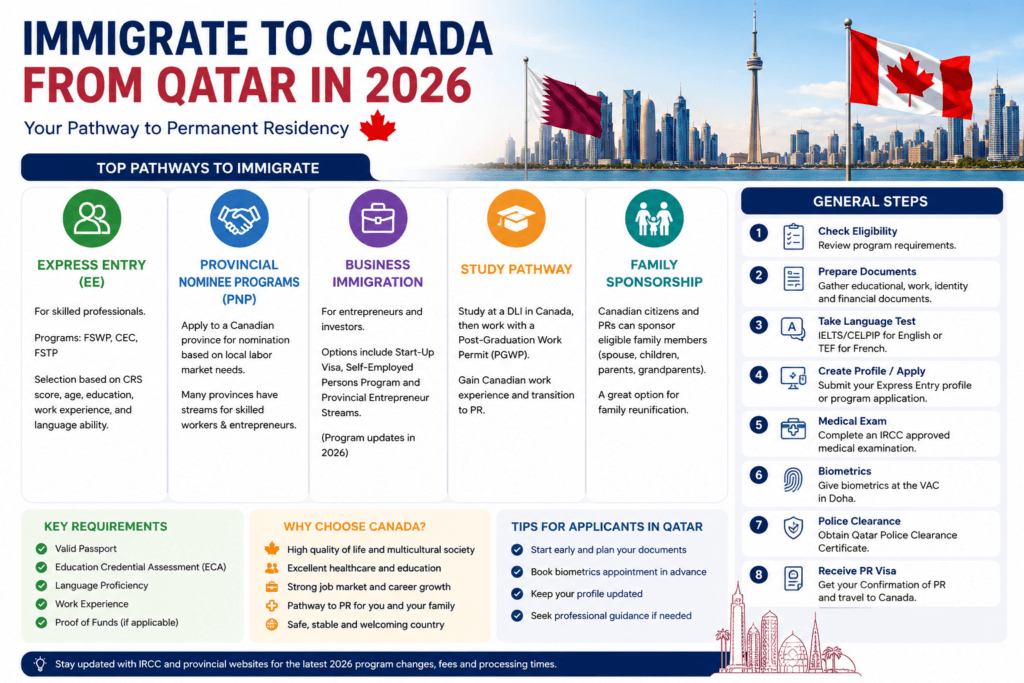
Pathway 1: Express Entry for Skilled Professionals
Express Entry is one of the strongest routes for skilled professionals living in Qatar. It manages applications for the Federal Skilled Worker Program, Federal Skilled Trades Program, and Canadian Experience Class.
Many Qatar-based applicants apply through the Federal Skilled Worker Program because it recognises skilled foreign work experience gained outside Canada. This can benefit professionals working in engineering, healthcare, aviation, finance, education, technology, and management roles in Qatar.
2026 Express Entry Category-Based Selection
In 2026, IRCC continues to use category-based Express Entry draws to invite candidates in priority areas. The official category-based selection page lists the current categories.
- French-language proficiency
- Healthcare and social services occupations
- STEM occupations
- Trade occupations
- Education occupations
- Transport occupations
- Physicians with Canadian work experience
- Senior managers with Canadian work experience
- Researchers with Canadian work experience
- Skilled military recruits
Applicants from Qatar may benefit from these categories if their occupation, language ability, and work experience match IRCC’s current definitions. However, category-based selection does not guarantee an invitation; candidates must still meet Express Entry program requirements and compete in the pool.
Proof of Settlement Funds
Many Express Entry applicants must show proof of settlement funds, unless they are exempt under IRCC rules. The official Express Entry proof of funds table lists the minimum required amounts.
| Family Size | Required Funds |
|---|---|
| 1 person | CAD $15,263 |
| 2 people | CAD $19,001 |
| 3 people | CAD $23,360 |
| 4 people | CAD $28,362 |
| 5 people | CAD $32,168 |
| 6 people | CAD $36,280 |
| 7 people | CAD $40,392 |
| Each additional family member | Add CAD $4,112 |
If your funds are held in Qatar, make sure your bank letters clearly show account numbers, opening dates, current balances, average balances, and legal access to the money. IRCC generally expects funds to be liquid, available, transferable, and not borrowed.
Pathway 2: Business Immigration from Qatar to Canada
Business immigration is still possible in 2026, but applicants need a more careful strategy because several federal business routes have been paused or reduced. For Qatar-based entrepreneurs, the most realistic options are usually a C11 entrepreneur work permit, an Intra-Company Transfer, or a provincial entrepreneur stream.
C11 Entrepreneur Work Permit
The C11 work permit is commonly used by entrepreneurs who want to establish, buy, or expand a business in Canada and can show that their work will create significant economic, social, or cultural benefit. This route falls under Canada’s International Mobility Program, which allows some LMIA-exempt work permits.
A strong C11 case should show active business ownership and management, not passive investment. Applicants usually need to demonstrate a real business plan, relevant experience, operating funds, and a credible benefit to Canada.
IRCC does not publish a fixed minimum investment for C11, so the right amount depends on the business model, province, industry, lease costs, hiring plan, and operating budget. Some practitioners use CAD $150,000 to CAD $200,000 as a planning benchmark, but this is not an official IRCC requirement.
C11 is not a permanent residence on its own. Entrepreneurs usually need a two-step strategy: first, enter Canada to operate the business, then pursue permanent residence through a Provincial Nominee Program or another eligible pathway.
Important C11 Limitation for Permanent Residence
Self-employed work experience usually does not count for Canadian Experience Class, which means many C11 business owners cannot rely on CEC alone for PR. IRCC explains Canadian Experience Class eligibility on its official CEC requirements page.
For this reason, Qatar-based business owners should plan their PR route before applying for a work permit. The safest approach is to match the business location with an active provincial entrepreneur stream from the start.
Intra-Company Transfer Work Permit
An Intra-Company Transfer may suit executives or senior employees of a Qatari or international company expanding into Canada. This route is designed for qualifying transfers between related companies, such as a parent, subsidiary, branch, or affiliate.
ICT applicants normally need qualifying experience in an executive, senior managerial, or specialised knowledge role. IRCC explains the rules for intra-company transferees in its official guidance.
| Situation | Best Option |
|---|---|
| You want to start your own Canadian business | C11 work permit |
| You want to buy and operate a Canadian business | C11 work permit |
| Your Qatar company is expanding to Canada | Intra-Company Transfer |
| You are being transferred by a multinational employer | Intra-Company Transfer |
| You want direct PR through business investment | PNP entrepreneur stream |
Pathway 3: Provincial Nominee Program Entrepreneur Streams
Provincial Nominee Program entrepreneur streams are often the most structured PR pathway for business owners. These programs usually require investment, active management, job creation, and a performance period before nomination.
British Columbia Entrepreneur Immigration
British Columbia entrepreneur immigration options are for applicants who want to start or buy a business in the province.
| B.C. Stream | Net Worth | Minimum Investment | Job Creation |
|---|---|---|---|
| Base Stream | CAD $600,000 | CAD $200,000 | 1 full-time job |
| Regional Stream | CAD $300,000 | CAD $100,000 | 1 full-time job |
The B.C. Regional Stream is especially relevant for applicants willing to invest outside Metro Vancouver. British Columbia’s regional immigration approach supports communities outside the Metro Vancouver Regional District through business and worker attraction.
Alberta Rural Entrepreneur Stream
Alberta’s Rural Entrepreneur Stream can be a strong option for business owners who are open to smaller communities outside Calgary and Edmonton.
- Minimum net worth: CAD $300,000
- Minimum investment: CAD $100,000
- Ownership: At least 51% for a new business
- Location: Rural Alberta community
- Required local step: Community Support Letter
This stream is best for applicants who are flexible about location and willing to build a business connected to a rural community’s economic needs.
Ontario Entrepreneur Stream
Ontario is not currently a practical entrepreneur-stream option for new applicants. The province announced that the Entrepreneur Stream would be wound down and closed after the earlier pause on accepting applications. You can verify this on the official Ontario Immigrant Nominee Program updates page.
If your goal is Toronto or Ontario, you may need to explore a federal work permit, Express Entry, an employer-supported Ontario stream, or a business plan in another province with an active entrepreneur pathway.
Pathway 4: Study-to-PR Route
Studying in Canada can still support a long-term PR plan, especially for younger applicants from Qatar who choose a program aligned with Canada’s labour market needs. However, this pathway is more regulated and financially demanding than before.
A typical study-to-PR pathway starts with admission to a Designated Learning Institution, followed by a study permit, an eligible Canadian credential, a Post-Graduation Work Permit, Canadian skilled work experience, and then Express Entry or a PNP.
IRCC requires students to show proof of financial support, including the ability to pay tuition, living expenses, and transportation.
Applicants in Qatar should prepare clear source-of-funds documents, especially if parents, sponsors, business income, or overseas accounts are involved. Weak financial documentation is a common reason study permit files become risky.
Pathway 5: Family Sponsorship and Super Visa
Family immigration may be available if you have a spouse, partner, child, parent, grandparent, or other eligible relative who is a Canadian citizen or permanent resident.
The most common family routes include spousal sponsorship, dependent child sponsorship, parent and grandparent sponsorship, and the Super Visa for parents and grandparents.
Super Visa Updates in 2026
Starting March 31, 2026, IRCC changed how income is calculated for Super Visa eligibility. The update gives some families more flexibility when proving the host’s financial ability to support parents or grandparents during their stay.
Canada’s official Super Visa update explains that income may be assessed using either of the two taxation years before the application, and in some cases the visiting parent or grandparent’s income may be included if the host meets the required minimum percentage.
Current Canada Immigration Fees in 2026
Canada increased permanent residence fees on April 30, 2026, so applicants should not rely on older fee tables.
| Fee Type | Current Fee |
|---|---|
| Right of Permanent Residence Fee | CAD $600 |
| Federal High Skilled or PNP principal applicant processing fee | CAD $990 |
| Accompanying spouse or common-law partner processing fee | CAD $990 |
| Dependent child | CAD $270 |
| Federal business principal applicant processing fee | CAD $1,895 |
| Biometrics for one person | CAD $85 |
| Biometrics family maximum | CAD $170 |
Before paying any government fee, check the official IRCC fee list, because fees may change and some programs have additional provincial or service charges.
Documents You May Need When Applying from Qatar
Your exact document checklist depends on the pathway, but most applicants living in Qatar should prepare core identity, education, work, financial, and background documents early.
- Passport with sufficient validity
- Qatar ID if you are a resident in Qatar
- Language test results such as IELTS, CELPIP, TEF, or TCF, depending on the program
- Educational Credential Assessment for many Express Entry applicants
- Employment reference letters with job duties, dates, salary, and hours
- Proof of settlement funds or proof of financial support
- Qatar Police Clearance Certificate and other police certificates where required
- Medical exam results if requested or required upfront
- Business documents for entrepreneur or investor routes
- Marriage, birth, or family documents for family-based applications
Applicants who have lived in multiple countries should plan extra time for police certificates. IRCC may ask for police certificates from countries where you lived for a certain period after turning 18.
Step-by-Step Process to Move from Qatar to Canada
1. Choose the Right Pathway
Start with your real profile, not with the pathway that sounds easiest. A skilled engineer, a business owner, a student, and a sponsored spouse will each need a different strategy.
2. Check Eligibility
Review your age, education, language score, occupation, work experience, funds, family situation, and preferred province. For Express Entry, you should also estimate your CRS score before investing time and money into the process.
3. Prepare Qatar-Based Documents
Gather Qatar-specific documents early, especially your police clearance, bank letters, residence documents, and employment records. Delays often happen when applicants wait until after receiving an invitation or document request.
4. Submit the Application Online
Most Canadian immigration applications are submitted online through IRCC or a provincial immigration portal. Upload clear scans, translate non-English or non-French documents when needed, and avoid inconsistent information across forms.
5. Complete Biometrics and Medical Exams
After receiving instructions, book your biometrics appointment through the official VAC system and complete any required immigration medical exam with an approved panel physician.
6. Wait for a Decision
Processing times vary by application type, country, and case complexity. Use Canada’s official processing times tool rather than relying on fixed timelines from older blog posts.
Easiest Ways to Immigrate to Canada from Qatar
There is no single easiest pathway, because the best option depends on your personal situation. However, some routes are usually stronger for specific applicant types.
| Applicant Type | Recommended Pathway |
|---|---|
| High-skilled worker with strong language scores | Express Entry |
| Engineer, healthcare worker, educator, STEM professional, or transport worker | Category-based Express Entry |
| Business owner with capital and management experience | C11 work permit plus PNP strategy |
| Investor open to smaller communities | PNP entrepreneur stream |
| Executive transferring from a company in Qatar | Intra-Company Transfer |
| Younger applicant planning education and work experience | Study permit, PGWP, then PR |
| Applicant with Canadian spouse or close family | Family sponsorship |
Common Mistakes Applicants from Qatar Should Avoid
One common mistake is choosing a pathway before checking eligibility. For example, a business owner may assume C11 leads directly to PR, when in reality, a provincial nomination strategy may be needed.
Another mistake is weak financial documentation. Bank statements should be consistent, traceable, and supported by official letters, especially when funds come from business income, family support, bonuses, or overseas transfers.
Applicants should also avoid relying on outdated program information. Canada changed several major immigration rules in 2026, including permanent residence fees, Super Visa income rules, temporary resident planning levels, and business immigration options.
Finally, do not ignore Qatar-specific logistics. Police clearance, biometrics appointments, document translations, and medical exams can all affect your timeline if you leave them until the last minute.
Final Advice for Qatar-Based Applicants
The strongest immigration strategy is the one that matches your actual profile. If you are a skilled professional, focus on Express Entry and category-based draws. If you are a business owner, plan beyond the work permit and choose a province with a realistic PR route.
If you are applying from Doha, prepare your local documents early and use official sources for every major requirement. This includes IRCC, provincial immigration websites, Qatar Ministry of Interior, and official Canadian application tools.
Canada is still open to qualified immigrants, but the 2026 system rewards applicants who are organised, well-documented, and strategic about their pathway from the beginning.
Disclaimer
This article is for general information only and does not provide legal advice. Canadian immigration rules, fees, processing times, category lists, and provincial requirements can change without notice. Always confirm details with official government sources or a licensed Canadian immigration professional before applying.