


An LMIA, or Labour Market Impact Assessment, is a document that a Canadian employer may need before hiring a temporary foreign worker.
The purpose of an LMIA is to assess how hiring a foreign worker could affect Canada’s labour market. A positive decision generally confirms that the employer needs a foreign worker and that no qualified Canadian citizen or permanent resident is available to fill the position.
This guide explains the LMIA meaning in Canada, how the process works, who must apply, and what happens after an employer receives a decision.
Quick answer: LMIA stands for Labour Market Impact Assessment. It is usually obtained by a Canadian employer—not the foreign worker—and may be required before the worker can apply for an employer-specific Canadian work permit.
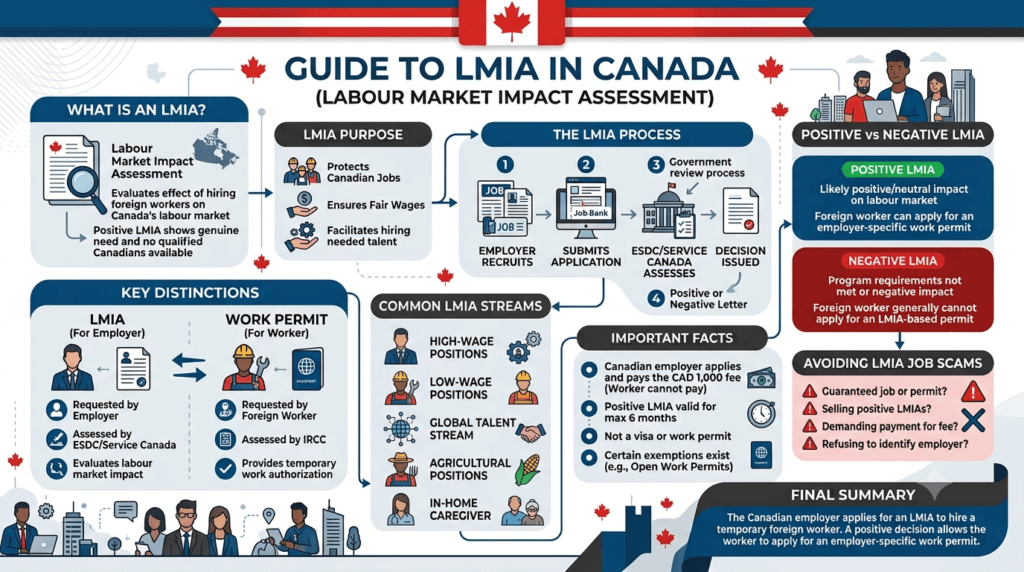
What Does LMIA Stand For?
The full form of LMIA is:
Labour Market Impact Assessment
“Labour” is the official Canadian spelling. You may also see the American spelling, Labor Market Impact Assessment, in online searches, but both refer to the same Canadian process.
An LMIA assesses whether hiring a temporary foreign worker is likely to have a positive, neutral, or negative effect on the Canadian labour market. Employment and Social Development Canada, commonly known as ESDC, processes LMIA applications through Service Canada.
Before the LMIA system, Canada used a process called the Labour Market Opinion, abbreviated as LMO. The Labour Market Opinion was replaced by the Labour Market Impact Assessment.
What Is the Meaning of LMIA in Canada?
In simple terms, an LMIA allows the Canadian government to check whether an employer has a genuine reason to hire someone from outside Canada.
As part of the assessment, the government may examine whether:
- The employer operates a legitimate Canadian business
- The job offer is genuine
- The employer can meet the offered employment conditions
- The wage is appropriate for the occupation and location
- Canadians and permanent residents were given a reasonable opportunity to apply
- Hiring the foreign worker would affect Canada’s labour market
The business and job offer must be genuine, connected to the employer’s reasonable business needs and financially supportable by the employer.
How Does an LMIA Work?
The LMIA process usually begins with a Canadian employer who cannot fill a position with a Canadian citizen or permanent resident.
- The employer determines whether an LMIA is required. Not every foreign worker requires an LMIA. The employer must first find out if you need an LMIA. Most employers using the Temporary Foreign Worker Program need an LMIA. However, an LMIA is generally not required when the worker already holds a valid open work permit or qualifies under an exemption. You can also review the full process on the official Government of Canada page on the Temporary Foreign Worker Program.
- The employer recruits within Canada. The employer may need to advertise the position and demonstrate reasonable efforts to recruit or train Canadian citizens and permanent residents. Recruitment rules depend on the LMIA stream, occupation, wage level and location. For example, current minimum advertising periods may differ between high-wage and low-wage applications.
- The employer submits the LMIA application. The employer or an authorized representative submits the application to Service Canada, normally through the LMIA Online portal. A Job Bank employer account is required to use the online application system.
- Service Canada assesses the application. Service Canada reviews the employer, job offer, recruitment activities, wages, working conditions and expected labour-market impact. The department may contact the employer for additional information or documents before making its decision.
- A positive or negative decision is issued. The employer receives an LMIA decision letter. When the decision is positive, the employer usually provides the foreign worker with the required LMIA documents so the worker can apply for an employer-specific work permit.
What Is a Positive LMIA?
A positive LMIA means Service Canada determined that hiring the temporary foreign worker would likely have a positive or neutral impact on Canada’s labour market.
It generally confirms that:
- There is a need for a foreign worker to fill the position
- No suitable Canadian citizen or permanent resident is available for the job
A positive LMIA may also be called a confirmation letter.
The employer must then provide the relevant documents to the foreign worker. The worker can use them when applying to Immigration, Refugees and Citizenship Canada, or IRCC, for a work permit.
Does a positive LMIA guarantee a work permit? No. A positive LMIA does not automatically give someone permission to work in Canada.
ESDC or Service Canada makes the LMIA decision, while IRCC separately decides whether to approve the foreign worker’s work permit application. The applicant must still satisfy all immigration, admissibility and document requirements.
What Is a Negative LMIA?
A negative LMIA means the employer’s application was not approved.
This may happen when Service Canada determines that program requirements were not met or that hiring the foreign worker could negatively affect the Canadian labour market.
For example, concerns may relate to recruitment efforts, wages, working conditions, business legitimacy or the availability of qualified workers in Canada.
Who Applies for an LMIA?
The Canadian employer applies for the LMIA.
A foreign worker cannot independently obtain an LMIA without a genuine Canadian employer and job offer. The employer may complete the application directly or appoint an authorized third-party representative.
After receiving a positive decision, the employer gives the required LMIA information and employment documents to the selected foreign worker.
This distinction is important:
- Employer: Applies for the LMIA
- Worker: Applies for the work permit
- Service Canada or ESDC: Assesses the LMIA
- IRCC: Assesses the work permit application
Is an LMIA a Visa?
No. An LMIA is not a visa, immigration status, or work permit.
An LMIA is a labour-market assessment connected to a specific employer and job. In many cases, it is one of the documents a foreign national needs before applying for an employer-specific work permit.
The term “LMIA visa Canada” and similar phrases are therefore technically inaccurate. The person normally applies for a Canadian work permit using the positive LMIA and supporting employment documents.
LMIA vs. Work Permit
An LMIA and a work permit serve different purposes.
| LMIA | Work Permit |
|---|---|
| Requested by the employer | Requested by the foreign worker |
| Assessed by ESDC or Service Canada | Assessed by IRCC |
| Evaluates the labour-market impact | Gives the person authorization to work |
| Connected to a specific job offer | Contains the worker’s employment conditions |
| Does not provide immigration status | Provides temporary authorization to work |
A positive LMIA may support a work permit application, but it is not the work permit itself.
What Is an LMIA-Exempt Work Permit?
Some foreign workers can obtain an employer-specific work permit without an LMIA. These cases are commonly processed through the International Mobility Program rather than the Temporary Foreign Worker Program.
See who is eligible for the International Mobility Program.
LMIA exemptions may be available because of international agreements, significant benefits to Canada, reciprocal employment arrangements, public policies, or other designated categories.
Open work permit holders also generally do not require an LMIA because their permits are not tied to one specific employer.
An exemption does not necessarily mean that no employer requirements apply. In many employer-specific LMIA-exempt cases, the employer must submit an offer through the Employer Portal and pay the applicable employer compliance fee before the worker applies.
How Much Does an LMIA Cost?
The standard LMIA processing fee in many Temporary Foreign Worker Program streams is currently CAD 1,000 for each position requested.
The fee is generally paid by the Canadian employer. Certain occupations or LMIA categories may qualify for a fee exemption.
The employer must not require the temporary foreign worker to pay or reimburse the government LMIA processing fee. Recruitment and certain representative-related costs also cannot be improperly recovered from the worker.
Applicants should be cautious when someone offers to “sell” an LMIA or demands payment in exchange for a guaranteed job, LMIA or work permit.
How Long Does LMIA Processing Take?
LMIA processing times depend on the program stream, application volume, and whether Service Canada requires additional documents.
The Government of Canada publishes average processing times by LMIA stream and updates the table monthly. These are averages rather than guaranteed completion dates and can change significantly from month to month.
Employers should also allow time for:
- Recruiting and advertising the position
- Preparing business and employment documents
- Responding to requests from Service Canada
- The worker’s separate work permit application
How Long Is a Positive LMIA Valid?
Positive LMIA decisions for applications received on or after May 1, 2024 are generally valid for a maximum of six months.
This is usually the period during which the foreign worker must submit the related work permit application. It is not necessarily the length of the worker’s authorized employment in Canada.
The exact expiry date appears on the LMIA decision letter.
Common LMIA Streams
The appropriate application stream depends on the job, wage, occupation, and purpose of the job offer.
Common categories include:
- High-wage positions
- Low-wage positions
- Global Talent Stream
- Agricultural positions
- Seasonal Agricultural Worker Program
- In-home caregiver positions
- Applications supporting permanent residence
- Dual-intent applications supporting both temporary work and permanent residence
Each stream has its own requirements relating to recruitment, wages, employment duration, employer responsibilities and supporting documents.
Can an LMIA Help With Permanent Residence?
An LMIA-backed job offer may be relevant to some Canadian immigration programs, but a positive LMIA does not automatically provide permanent residence.
The foreign worker must still meet the eligibility and selection requirements of the immigration program through which they apply.
Does an LMIA give Express Entry CRS points?
As of March 25, 2025, IRCC no longer awards additional Comprehensive Ranking System points simply for having a qualifying job offer. This includes job offers that previously received 50 or 200 CRS points.
A valid job offer may still be relevant to eligibility under certain Express Entry programs or other immigration pathways, even though it does not currently provide those additional CRS points.
Because immigration policies can change, applicants should check the latest IRCC rules before relying on an LMIA or job offer as part of a permanent residence strategy.
How to Avoid LMIA Job Scams
A genuine LMIA is connected to a real Canadian employer, a legitimate business, and a specific job offer.
Be cautious when someone:
- Guarantees an LMIA or work permit
- Offers to sell a positive LMIA
- Asks the worker to pay the employer’s LMIA fee
- Refuses to identify the Canadian employer
- Provides job documents with inconsistent duties, wages, or contact information
- Claims that a positive LMIA guarantees permanent residence
- Pressures the applicant to send money immediately
Canadian employers are responsible for paying the LMIA processing fee, and approval is never guaranteed. The government may also inspect employers and penalize businesses that fail to follow Temporary Foreign Worker Program requirements.
Frequently Asked Questions
What is the full form of LMIA in Canada?
The official LMIA full form is Labour Market Impact Assessment.
Is LMIA required for every Canadian work permit?
No. Some workers qualify for LMIA-exempt employer-specific permits or open work permits. The requirements depend on the worker’s situation and work permit category.
Can a foreign worker apply for an LMIA?
No. The Canadian employer applies for the LMIA. The foreign worker normally applies for a work permit after receiving the required documents from the employer.
Is LMIA the same as a job offer?
No. A job offer is an offer of employment from a Canadian employer. An LMIA is a government assessment of the employer’s request to hire a foreign worker.
Is LMIA the same as a work visa?
No. An LMIA is not a visa or work permit. It may be used to support an application for an employer-specific work permit.
What is the difference between LMO and LMIA?
LMO stands for Labour Market Opinion and was the former system. It was replaced by the Labour Market Impact Assessment process.
Final Summary
LMIA stands for Labour Market Impact Assessment. It is a process used by the Canadian government to determine whether an employer has a genuine need to hire a temporary foreign worker and how that hiring could affect workers in Canada.
The Canadian employer applies for the LMIA. If the decision is positive, the selected foreign worker may use the LMIA and job documents to apply for an employer-specific work permit.
An LMIA is not a visa, does not guarantee a work permit, and does not automatically provide permanent residence. Employers and foreign workers should always review the latest official requirements because LMIA rules, wage thresholds, recruitment conditions and immigration policies can change.